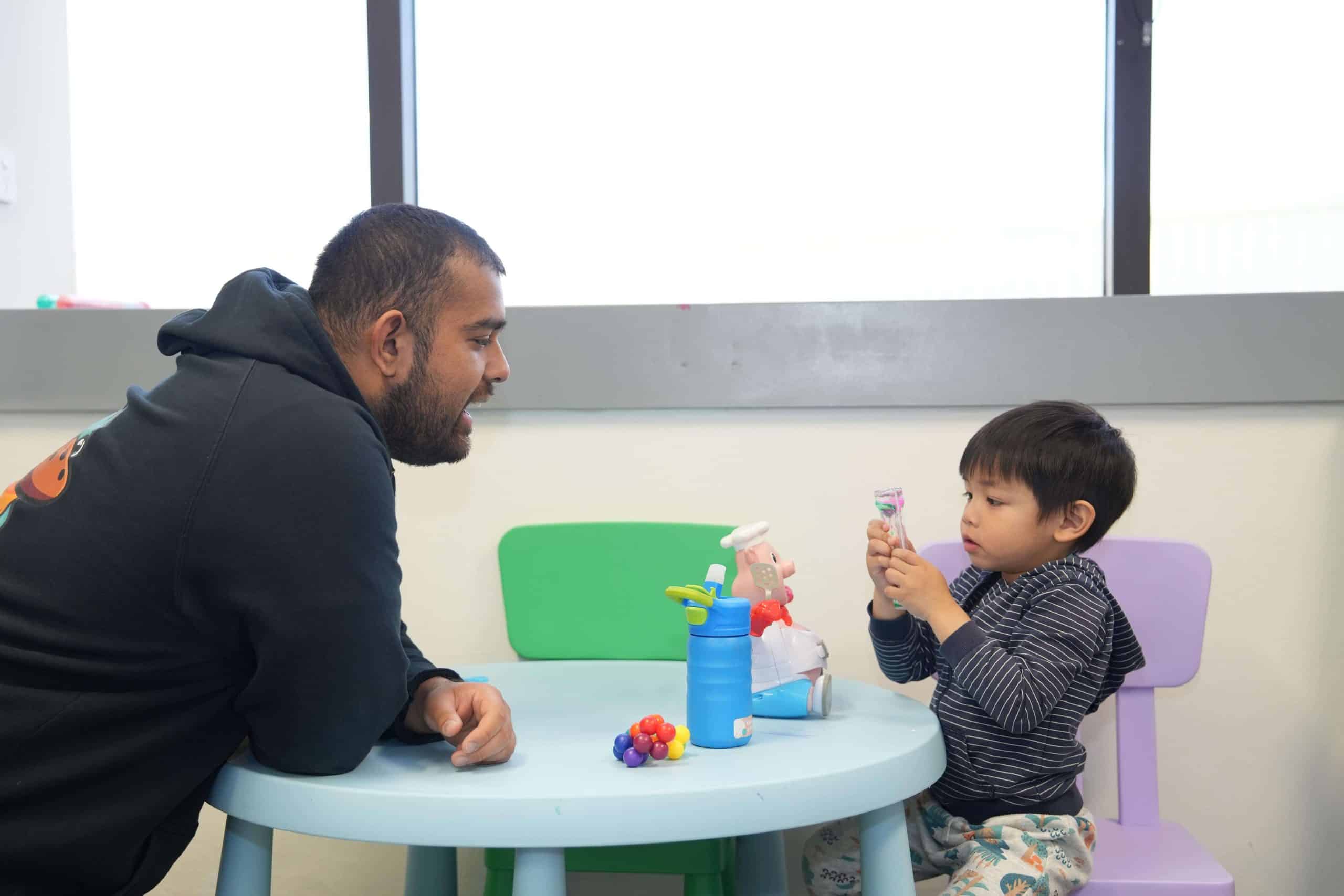
Most participants who have both an occupational therapist and a speech pathologist have two separate services that never speak to each other. Two reports, two sets of goals, two lots of homework for the family, and a quiet duplication of the therapy budget.
It does not have to work that way, and where it does not, plans go further. This page explains how the two disciplines overlap for participants across Blacktown, Penrith, Campbelltown and the surrounding suburbs, and how to set the arrangement up properly from the start.
Disclosure. Meta Healthcare delivers both occupational therapy and speech pathology. We are one option among many in Western Sydney and you are free to use any provider, or to use different providers for each discipline. This page describes how we think the two should be coordinated, whoever delivers them.
What each discipline owns
Occupational therapy works on doing: the practical tasks of a day, the environment those tasks happen in, and the equipment that makes them possible. Showering, dressing, cooking, getting out of the house, managing fatigue, sensory needs, getting the bathroom to work for the body that uses it.
Speech pathology works on communicating and, less well known, on swallowing and mealtime safety. Speaking, being understood, understanding others, using communication devices and boards, and eating and drinking safely.
Two different jobs. Read a real day and they collide constantly.
One goal, two disciplines
Take a goal a lot of participants actually name: I want to order my own coffee and pay for it without help.
- The speech pathologist works on the request itself, and on what happens when the barista does not understand the first time. For a participant who uses a communication device, that includes having the order programmed and reachable.
- The occupational therapist works on getting there, on managing money, on the noise and the queue, and on the sequence of steps in the right order.
Run separately, that goal becomes two goals that each half-work. Run together, one person practises the ordering while the other sets up the trip, and the participant does the whole thing once rather than two halves twice.
The same pattern applies to mealtimes, where a speech pathologist may be managing swallowing safety and texture while an OT is working on seating, utensils and the sequence of preparing food. Those two things are one meal.
[FORM: “Ask about OT and speech availability in your suburb” – see form_spec]
How to make two therapists behave like one team
Whether both disciplines come from the same provider or from two, four things make the difference:
- Write shared goals, not parallel ones. One goal statement both therapists work to, in the participant’s words.
- Give explicit consent for them to talk to each other. Without it, they cannot, and most of the value evaporates. Ask for it to be set up at intake.
- Agree who leads. For a communication-driven goal that is usually the speech pathologist. For an environment-driven goal it is usually the OT. Someone should own it.
- Ask for one combined update before a plan reassessment, not two reports that repeat each other’s background sections.
If both disciplines come from one provider, ask directly how often the therapists meet about your case and whether that time is billed. A team that has never had a conversation about you is two solo services under one logo.
Funding: how it sits in a plan
Both occupational therapy and speech pathology are therapy supports and generally sit in the Capacity Building part of a plan, most often under improved daily living.
The practical consequences:
- The pool is usually shared. Two disciplines are often drawing on the same therapy allocation, so hours spent on one are hours not available for the other. That is exactly why coordinating them matters financially, not only clinically.
- Capacity Building funding is generally category-specific, so it cannot simply be moved from therapy to something else.
- Equipment and communication devices are funded differently, usually from the Capital part of a plan, and normally require an assessment first.
- The NDIA decides what is funded. The primary source is supports funded by the NDIS, not any provider’s page, including this one.
If your therapy hours are tight, our guide on using therapy hours wisely covers how to prioritise.
Where we deliver
Our allied health team works across [SERVICED SUBURB LIST], covering the Blacktown, Penrith and Campbelltown corridors. Current availability is [CURRENT WAIT TIME] per discipline.
If you want just one discipline, go straight to the service page for occupational therapy or speech pathology. Support coordinators placing participants should use the referral form.
[FORM: repeat “Ask about OT and speech availability in your suburb” – see form_spec]
Frequently asked questions
Do I have to use the same provider for both?
No. Using one provider makes coordination easier, but two providers who communicate beat one that does not.
Can both therapists attend the same session?
Sometimes, and for goals that genuinely sit across both it can be the most efficient use of hours. It uses two lots of billing for the same block of time, so it should be a deliberate choice.
My plan only funds one. Which comes first?
It depends on which barrier is doing the most damage right now. If nobody can understand the participant, start with speech. If the participant cannot safely get through a morning, start with OT. A short consult with either discipline will usually answer it honestly.
Is this only for children?
No. Adults use both, particularly after an acquired injury or with a progressive condition.

Meta Healthcare is a leading NDIS provider in Sydney, dedicated to empowering participants through personalised care and expert guidance. Our compassionate team focuses on creating meaningful opportunities, fostering independence, and supporting brighter futures for individuals and their families. With over 60 years of combined experience, we offer a range of services, including support work, allied health, support coordination, and respite care, all tailored to meet each participant’s unique goals and needs. At Meta Healthcare, we prioritise transparent communication, inclusivity, and a goal-oriented approach to help you thrive in your journey with the NDIS.